Victorian Landcare Magazine - Spring 2025, Issue 90

Salinity and rising water tables across northern Victoria were the bane of farmers, communities and governments in the 1980s and 1990s.
These and other significant environmental problems, such as erosion, weeds and rabbits, were among the catalysts for establishing Landcare and drainage groups in the irrigation zones of the Goulburn Broken and North Central catchments.
This year Goulburn Murray Landcare Network (GMLN) marks three decades of supporting those groups across an area covering 3000 square kilometres around Shepparton.
GMLN chair John Laing said there were originally 68 groups in the region, which is known for its dairy and fruit and vegetable production.
“It was easy to mobilise local communities, because we were all faced with the same dilemma,” he said.
“We all had a common issue, so getting us all involved was certainly a lot easier, and there was a lot of support from government departments at the time.”
Government support included providing farm advisers and ethnic liaison officers, in recognition of the multicultural nature of agriculture in the area, which is home to farming families from diverse backgrounds and heavily relies on seasonal workers from overseas.
Green Corps and Work for the Dole teams also undertook training and work experience while helping with monitoring, restoration and revegetation programs.
John said being able to offer on-ground help from those teams was a huge incentive for farmers to get involved, whether it was putting a groundwater test well on their property or planting trees.
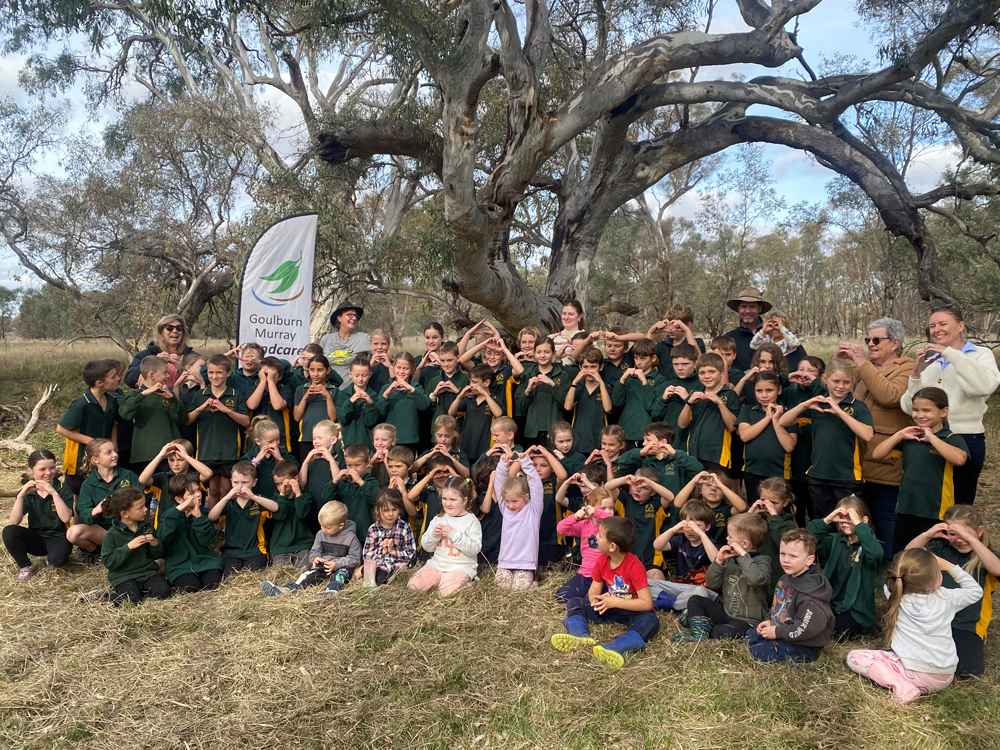
Above: Students from Colbinabbin Primary School and Kinder visit the bush kinder site to celebrate World Turtle Day as part of Goulburn Murray Landcare Network’s Biodiversity Education Aquatic Discovery program.
Today, GMLN employs three part-time staff, including two Landcare facilitators funded by the Government’s Victorian Landcare Facilitator Program. It supports 22 active Landcare groups, reflecting both the changing face of agriculture and the evolving needs of the community.
Farms have increased in size, replaced workers with machinery, adopted more efficient irrigation systems and there has been a decline in food manufacturing.
“There’s one corporation up to the north of us, and they gobbled up 60 of the local farms,” John said.
“We’ve lost a lot of our small farms and with that, the people that contributed to the Country Fire Association, the Country Women’s Association, Landcare and everything else that happens in our region.”
The shift from traditional information sharing to digital platforms has also changed how the network connects with its community.
And while email newsletters and social media allow GMLN to share information about the importance of natural resource management with many more people, John said it was a challenge to get cut through and engage the community.
Even so, the network continues to have an impact, encouraging the exchange of ideas and experiences between Landcare groups, providing a regional employment service for community groups, and influencing regional planning, policy development and decision making.
Environmental education remains a cornerstone of its work. GMLN reaches more than 2000 students and community members each year through biodiversity education and discovery programs, and more than 840 participants with its week-long Floodplain Ecology Course, annual farm forums, soil health and regenerative grazing workshops, and other projects.
John, who has been GMLN president for 10 years and a volunteer for 30 years, takes a hands-on role in many of these activities, bringing along “Mini Beasts” – spiders and insects he collects from the 1.6ha home block at Old Toolamba that he and wife Rhonda have spent decades turning into a bush haven for native plants, animals and invertebrates.
As GMLN prepares to mark its 30th anniversary, there is a strong sense of pride in past achievements, and recognition of the opportunity the milestone offers to reflect, refocus and inspire renewed community action for the decades ahead.
A volunteer-run organisation, the network is not just about the land: it’s also about people, connection and thriving communities. In 2023–2024 alone, volunteers racked up 5891 hours – equal to $245,949 of in-kind contributions – protecting and enhancing the environment.
And while some of the original issues may have taken a back seat in recent times, John said there was still a lot to be done.
Fortunately, many retired farmers, who had moved into towns or rural lifestyle blocks, were now actively sharing their knowledge and experience in newer urban Landcare groups which were attracting the next generation of members.
“It’s changed a little bit,” John said.
“But the focus is still on bringing people together to solve problems.”
GMLN receives funding from Victorian Government Landcare Grants, Australian Government and the Goulburn Broken CMA.
John Laing is president of Goulburn Murray Landcare Network and a member of Dhurringile and District Landcare Group.
For more information email info@gmln.com.au or go to www.gmln.com.au.