
Victorian Landcare Magazine - Spring 2025, Issue 90

Multispecies pastures may hold the key to building more profitable and climate resilient farm businesses.
A two-year trial on a commercial dairy farm at Waratah Bay in South Gippsland found numerous benefits from multispecies pastures compared to conventionally farmed pasture mixes of ryegrass and clover, and millet and forage rape.
Importantly, the cost per tonne of dry matter from the multispecies pasture in the Farmers Digging Deeper project, was half that of the conventional pasture.
The results were a pleasant surprise for Stuart Tracy, who milks 600 Friesian and crossbred cows with his wife Jacqui, their son Angus and his wife Ruby.
“It’s blown me away,” he said.
“I would not have fathomed we’d see the regenerative outyield the conventional … it justifies our move to a regenerative approach for our farm.”
Stuart’s interest was piqued by a 2019 South Gippsland Landcare Network (SGLN) project, Enhancing Soil Biology, which he joined to learn more about the science underpinning regenerative grazing management.
With support from SGLN and soil microbiologist Dr Mary Cole, Stuart and 29 other farmers tested, monitored and evaluated three different soil treatments on their properties.
The treatments were aeration with a Yeoman’s plough, aeration plus seaweed, and aeration plus mycorrhizal fungi.
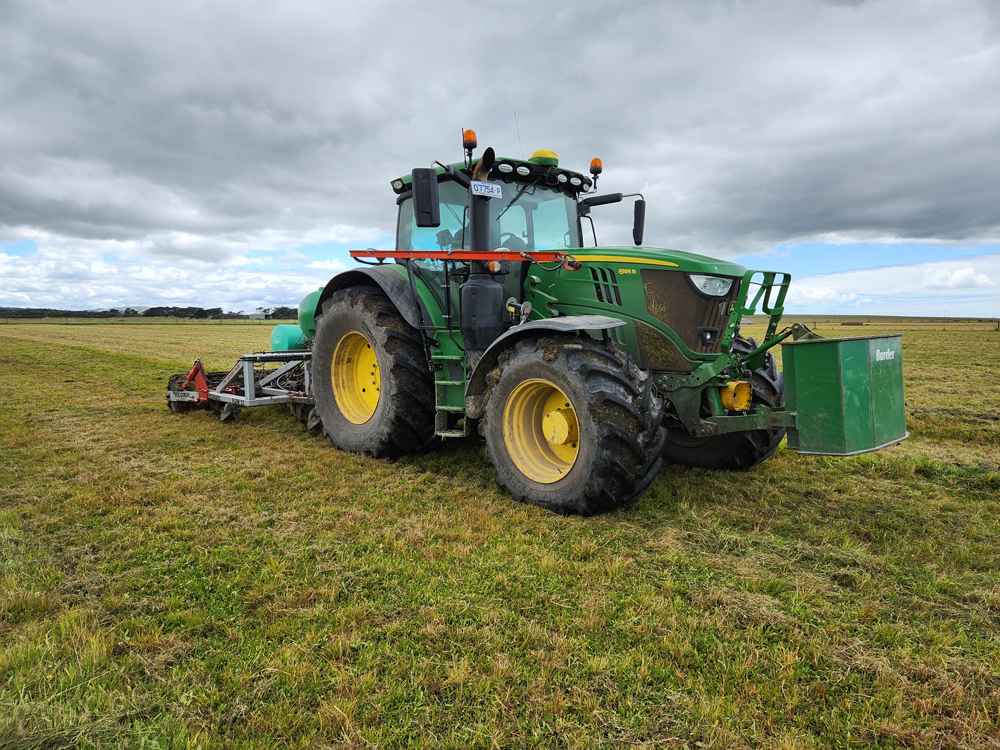
Above: Making a pass over the pasture with a Yeoman’s plough to aerate the soil.
“We did our trial plots and I noticed a difference in that … so it made me want to get more involved,” he said.
Stuart was keen to see whether a more regenerative approach to farming in such a high rainfall environment, with average annual rainfall of 1000 millimetres, could be economically viable and allow them to reduce spending on expensive chemical fertilisers.
The 6 hectare demonstration site was established in May 2022 as part of the Farmers Digging Deeper project.
The aim was to measure the quality, quantity, production costs and soil health impacts of multispecies pastures and regenerative grazing management.
One side of the paddock was sown with a conventional mix of ryegrass and clover in summer and millet and forage rape in winter, which was fertilised with diammonium phosphate (DAP) and urea.
The other side was sown to a multispecies mix of millet, forage rape, tillage radish, chicory, vetch, clover, buckwheat, sunflower and linseed in summer, followed by millet, forage rape, tillage radish, chicory, vetch, clover, ryegrass and oats in winter.
It was fertilised with humates, fish and kelp emulsion, molasses and biocast from worms, and mulched, with the aim of feeding soil microbes.
A comprehensive monitoring program measured all inputs and outputs associated with sowing, maintaining and grazing both sides of the paddock.
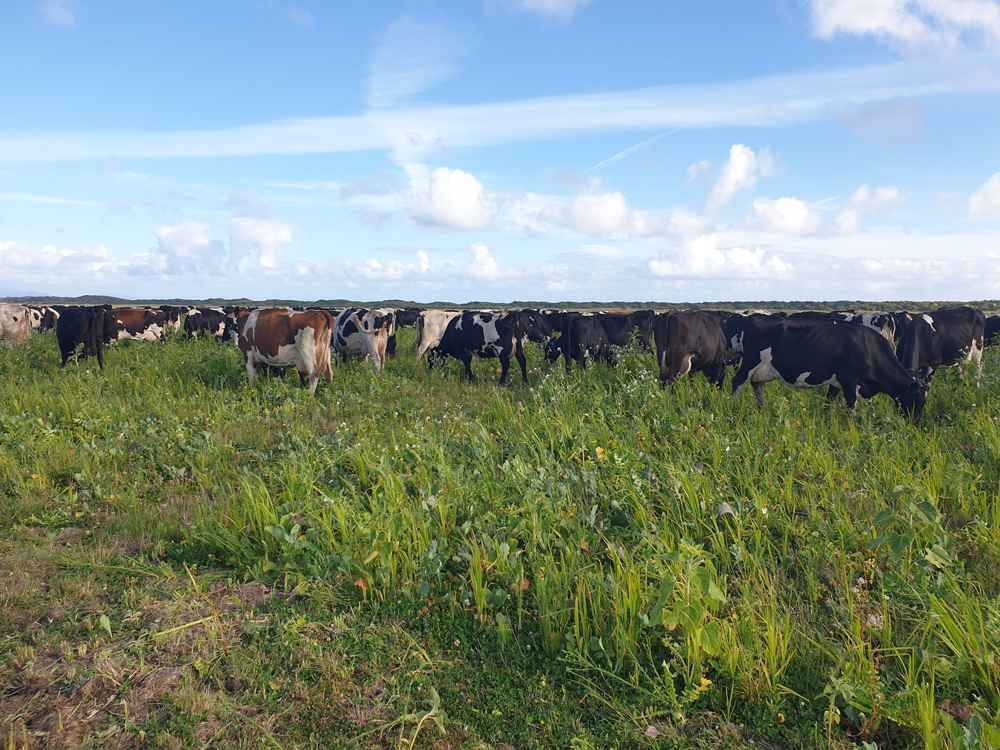
Above: The Tracys’ herd of milkers graze happily in the summer multispecies pasture at Waratah Bay.
Before the trial, Stuart expected the cost of producing the multispecies pasture to be lower than the conventional pasture but thought the conventional pasture would outyield it.
Much to his surprise, the multispecies pasture outperformed the conventional pasture on nearly every indicator, including dry matter, metabolisable energy (ME), protein, non-fibre carbohydrates (NFC) and calcium.
Better still, the cost of producing a tonne of multispecies pasture dry matter was half that of producing a tonne of conventional dry matter.
“Even if we don’t outyield we’re ahead,” Stuart said.
“But to do both is outstanding – it’s a double benefit.”
Agronomist Jade Killoran said the demonstration trial showed the multispecies pasture was healthier and more resilient than the conventionally managed species.
It hosted large numbers of beneficial insects and birds, resisted pest attack, and stood up better to hot and dry conditions.
“Another exciting finding was the improvement in the soil,” Jade said.
“The multispecies pasture had been sown on the ‘sub-optimal’ half of the paddock where the soils were heavier and poor draining. At the end of the trial, the soil was far more aerated and had much higher levels of soil biology – including twice as many earthworms – than the conventional plot.”
This was good news for the Tracys, who had noticed their pastures seemed to be losing vigour and required frequent oversowing. They were also concerned about increasing levels of fungal diseases such as perennial ryegrass toxicosis, also known as ryegrass staggers, impacting the health of their herd.

Above: Angus Tracy (far right) and his father Stuart Tracy (second from right) join other farmers at a field day with multispecies cropping advocate Grant Sims.
The trial results have given the Tracy family the confidence to accelerate adoption of regenerative practices more broadly across the farm business.
Multispecies pastures are being expanded as they transition from annual to perennial pastures.
Stuart said they would continue refining their techniques to reduce phosphorus, potash and urea use, and have started making their own biofertilisers.
SGLN has developed an extensive library of resources to help farmers interested in regenerative agriculture which can be accessed at www.sgln.net.au.
The Farmers Digging Deeper – Regional Soil Health project ran from 2022 to 2024 and was funded through the Australian Government’s National Landcare Program. It was facilitated by the Western Port Catchment Landcare Network and involved SGLN, Bass Coast Landcare Network, Latrobe Catchment Landcare Network, Melbourne Water and Mornington Peninsula Shire Council.
Jillian Staton is chair of the South Gippsland Landcare Network and a member of the Tarwin Lower Landcare Group. Cassie Wright is SGLN Projects and Education Co-ordinator.
For more information, email cassie@sgln.net.au.