
Victorian Landcare Magazine - Spring 2025, Issue 90
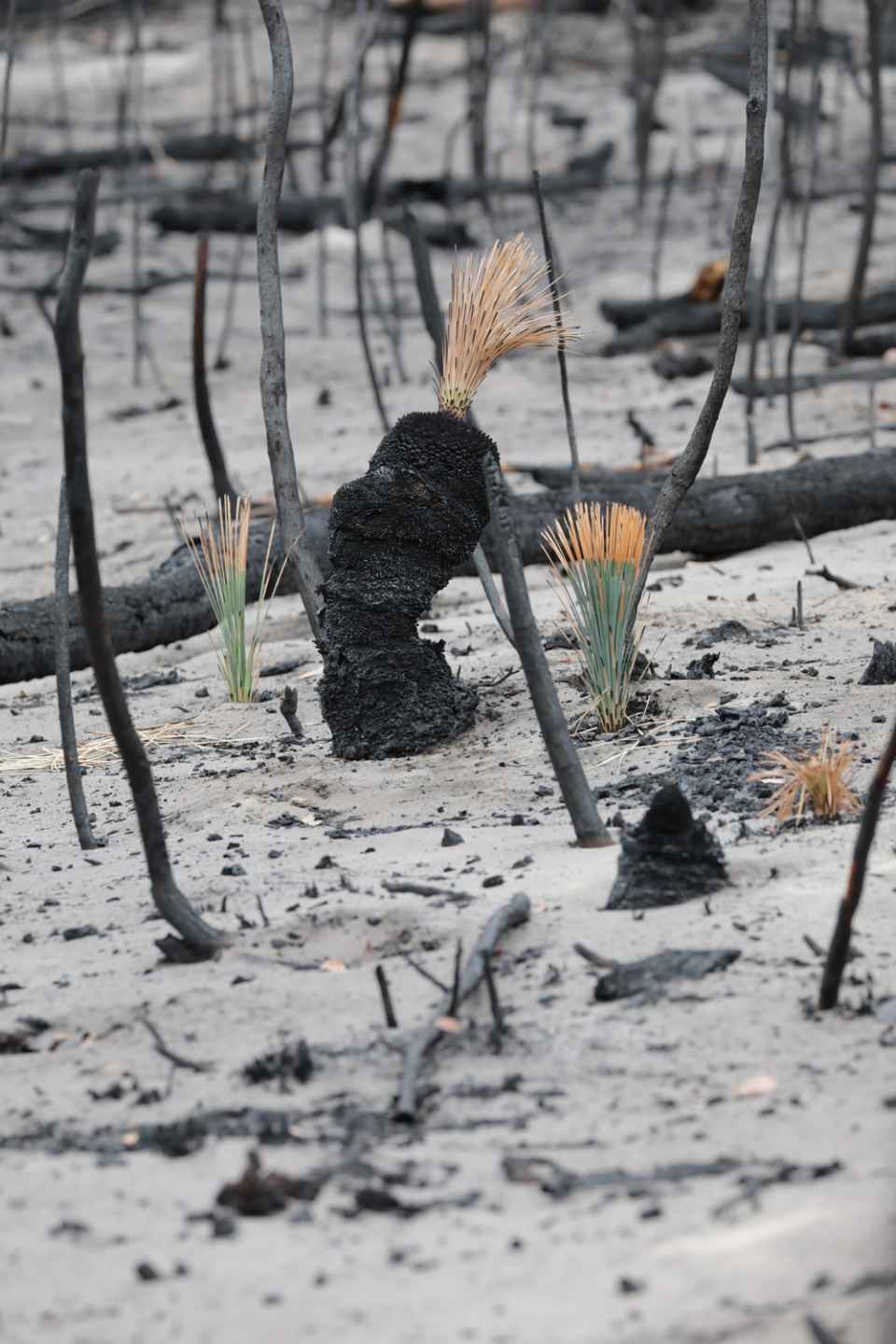
Fire has been a feature of the Australian landscape for millions of years – so long that many of our native plants have evolved ways of withstanding or even taking advantage of periodic burning.
But the fires that swept through the 168,000 hectare Grampians National Park (Gariwerd) in recent summers were both more intense and extensive than usual.
Lightning strikes ignited fires that burned more than 6500 hectares along the eastern flank of the park in February 2024 and another 135,000 hectares – more than 70 per cent of the park area – in the summer of 2024–25.
The blazes destroyed homes and livestock on adjacent farms, as well as impacting native plants, animals, aquatic species and invertebrates, leaving swathes of the park’s landscape “like the surface of the moon”.
The heat was so intense that even fire-stimulated native species struggled to regenerate in some areas, with significant losses of key flora such as cypress pines (Callitris spp) and yellow box (Eucalyptus melliodora).

Above: A water bombing helicopter returns to Stawell after a day fighting fires in the Grampians National Park (Gariwerd) in December 2024. Photo: Will Hudson.
“In a lot of cases, we’re not seeing the recruitment of native species within their distribution ranges,” Parks Victoria pest plant project officer Sarah said.
“We’re seeing stimulation of the grass trees (Xanthorrhoea spp) and other plants that you expect to see post-fire and then there’s other parts of the park that look like the surface of the moon. There’s just nothing there.”
Disaster recovery efforts began immediately after areas were deemed safe, with Forest Fire Management (FFM) and Parks Victoria personnel clearing tracks. They also brought in emergency food supplies and temporary shelters for small animals that had been left homeless and vulnerable to starvation and predation from foxes and cats, which quickly moved into the newly exposed landscape.
“Foxes were there overnight,” Sarah said.
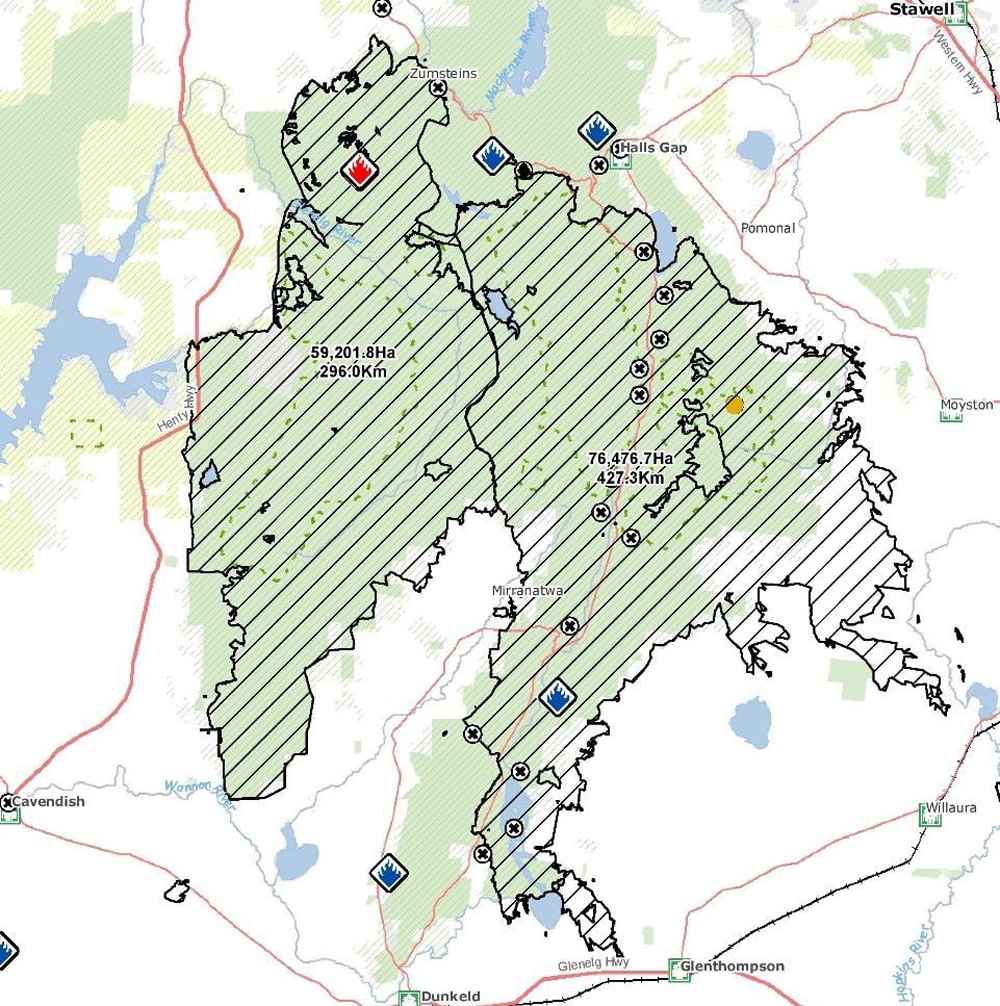
Above: More than 70 per cent of the 168,000 hectare Grampians National Park (Gariwerd) burned during the summer 2024-25 fires.
Under Sarah’s direction, Landmate crews are also making a difference on the ground. Their focus is on woody weed removal – especially sallow wattle (Acacia longifolia) and the invasive kunzea (Kunzea leptospermoides), which is an emerging threat to biodiversity and fire management.
The Landmate program is a partnership between Corrections Victoria and the Victorian Government’s Landcare Program, which has invested more than $5.7 million in it since 2006.
The program combines environmental management with rehabilitation for prisoners nearing release and provides free or low-cost, skilled labour for restoration work.
Sarah said Landmate crews had covered more than 400 hectares of the park in the past two years, treating blackberries (Rubus fruticosus) and periwinkle (Vinca major), and cutting sallow wattle below the lowest growth node to kill it.
A native of New South Wales but a weed in Victoria, sallow wattle is a prolific seed producer and especially problematic in fire-affected landscapes.
“Ants take the seed down into the ant nest, so it’s insulated against fire,” Sarah said.
“Once we have good rains after fires, it stimulates the seed growth; it comes back as a monoculture, crowding out everything else and changing the biology of the soil. Once it establishes, it becomes the only thing in the landscape.”
The kunzea weed, meanwhile, is a more recent and less understood invader.
Sarah said it looked like a tea tree and smelled like a tea tree, but had a different canopy and distinctive flowers, and did not respond well to herbicides.
“It’s an imposter that grows to about 3 metres high and crowds out to become huge hedges,” she said.
Parks Victoria is working with Northern Grampians Shire, Landcare groups, Project Platypus, VicRoads, DEECA, FFM and the CFA to remove kunzea from the landscape and research the best treatment options.
“Halls Gap Landcare has been leading kunzea removal around the township,” Sarah said.
“We really only work on our tenure, and then on the other side of the fence, we’ve been in partnership with Landcare, high fiving them over the fence.”
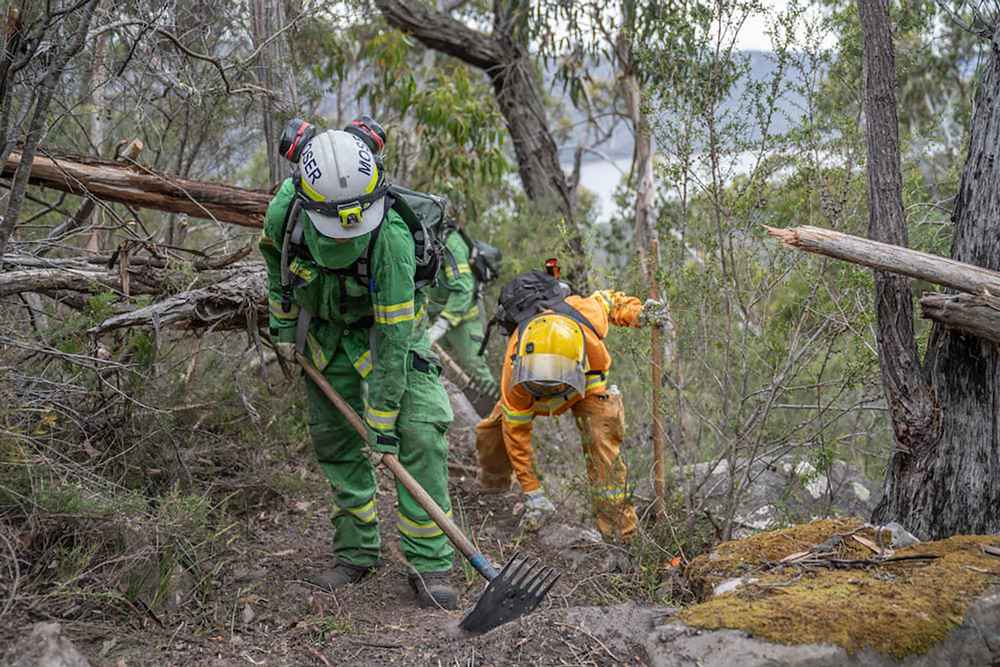
Above: Parks Victoria and Forest Fire Management staff clear debris from paths in Grampians National Park (Gariwerd).
For the prisoners who take part, the Landmate program offers a unique opportunity to develop practical skills through meaningful work, build confidence, and contribute positively to society before reintegrating with the community.
“It gave me a sense of purpose,” said one participant, who cannot be named.
“Being part of Landmate helped me feel useful again. I could see the difference I was making in the community.”
Another said learning how to work in a team, follow instructions and use tools had been a confidence booster.
Sarah said the Landmate program had broader social benefits, giving the prisoners, who are mostly men nearing the end of their sentence, experience at working with female leaders, learning how to do weed assessments, and to value the environment and cultural heritage.
“They talk to their families about the work that they’re doing,” she said.
“So there’s this real benefit of building a value around conservation with their families as well, that benefits everybody going forward.”
Corrections Victoria Landmate and Agriculture Manager Andrew Marx said the Landmate program had been operating in Victoria for more than 25 years, evolving to include support for disaster recovery – from floods as well as fires – facility maintenance, environmental grants and public land projects.
Community partnerships include Landcare groups and networks, catchment management authorities, water authorities and local government.
Andrew said eight crews operated from prisons across the state, including Hopkins and Beechworth correctional centres, Langi Kal Kal Prison, and the Tarrengower women’s prison.
“They need to meet certain criteria to be approved for Landmate,” he said.
“The program is multi-faceted in its benefits to the environment and community, while also allowing participants the opportunity to learn employable skills and assist in their transition back into the community.”
The program’s success is reflected in its outcomes. Since 2016, Landmate crews have contributed more than 30,300 days of environmental work across Victoria, planted more than 237,000 trees and installed more than 320 kilometres of fences. They have also cleared more than 660 hectares of woody weeds since 2020.
In the Grampians, the focus is now shifting towards revegetation, with plans for large-scale planting projects to follow the weed removal work.
The 2024-25 summer fires in Grampians (Gariwerd) National Park resulted in the closure of many popular visitor sites including campgrounds, picnic areas, roads and walking tracks.
Facilities are gradually being reopened and visitors are urged to drive slowly and carefully through the area to avoid hitting animals attracted to feed on fresh plant growth along the roadside.
Hikers and bushwalkers are also asked to take care not to stray from established tracks in burn scars to allow regenerating plants to re-establish soil integrity.
“It’s important not to break the surface of that soil by walking through it, because that is its ability in the future, to be able to hold moisture,” Parks Victoria pest plant project officer Sarah said.
“By trampling through these spaces, we could create desert tracks where nothing will grow again.”
Some of this work has been completed under the project, Healing Gariwerd (the Grampians National Park) through Bushland Restoration, as part of the DEECA funded BushBank public land restoration grants program, and the Protecting Biodiversity Sallow Wattle Project.
To learn more about how the Landmate program could help with your Landcare group or network project, email andrew.marx@justice.vic.gov.au or go to www.landmate.vic.gov.au.